For the last few months my laptop has been the bottleneck in my own workflow. Not the CPU, not the RAM – the fact that it’s a laptop.
I run long AI coding sessions now. Claude Code churns away on a feature for twenty minutes, I go make coffee, and if I close the lid the session dies with it. So for a while I did the obvious dumb thing: I kept the Mac awake with Amphetamine , lid open, plugged in, sitting on a desk I then couldn’t walk away from. The machine doing the work had to be the machine in front of me, powered on, present. That’s backwards.
So I moved the whole thing off my laptop. There’s now a server that runs the agents, the code, the databases, and the editor GUI. I reach it from my MacBook at my desk, from the couch, or from my phone on the train. Close the laptop, the work keeps running on the server. Open my phone twenty minutes later and I’m looking at the exact same session, right where it was.
If you’ve used Claude Code’s Remote Control to pick a session up from the phone app, it’s a bit like that, except it’s on by default, running all the time, and it’s my own server with none of the limits. Every project I have, not just the one I remembered to start a remote session for.
This post walks through how it’s built and why each piece is there. It’s also written so you can hand the whole thing to an LLM and have it build the same setup for you. More on that at the end, but keep it in mind as you read: everything here is a real command I ran on a real server, not a sketch.
What you get#
A server in the cloud isn’t new, I’ve had those for twenty years. What’s new is that the machine doing the work is no longer tied to the machine I’m sitting at.
- I can close my laptop. The agent, the editor, the database, all of it lives on the server. My laptop is a window, not the engine. Shut the lid, get on a train, nothing stops.
- I hand off between devices instantly. Start a task on the MacBook, check on it from my phone in the kitchen, back to the desk. Same session, same state, no syncing, no “let me push this real quick so I can pull it elsewhere”.
- It survives a dropped connection. My train goes through a tunnel, SSH drops, the work on the server doesn’t care. I reconnect and reattach.
- No more caffeine hacks. Amphetamine, Caffeine,
caffeinate, the littlewhile true; do; donetricks, … all gone. The laptop is allowed to sleep because it isn’t doing anything important.
It all rests on three pieces: a network layer (Tailscale), a server, and a coding GUI you reach from a browser (I use T3, but that part is swappable). Then a bunch of small tweaks on top that make it pleasant instead of fiddly.
Tailscale: the network that makes it private#
The first problem with “a server I reach from anywhere” is the “from anywhere” part. You do not want an editor with a shell on it exposed to the open internet. That’s how you end up in someone’s botnet.
Tailscale solves this cleanly. It’s a mesh VPN built on WireGuard , but you never touch a WireGuard config. You install a client on each of your devices, log in, and they all end up on one private network (a tailnet) where they can talk to each other directly, encrypted, no matter which network they’re physically on. My laptop, my phone, and the server all see each other as if they were on the same LAN, whether I’m at home, on cellular, or on hotel wifi.
There are proper native clients for everything: macOS, Windows, Linux, iOS, and Android. On the phone it’s an app-store install and a login, that’s the whole setup. Once a device is on your tailnet it can reach the server by name, and nothing outside the tailnet can.
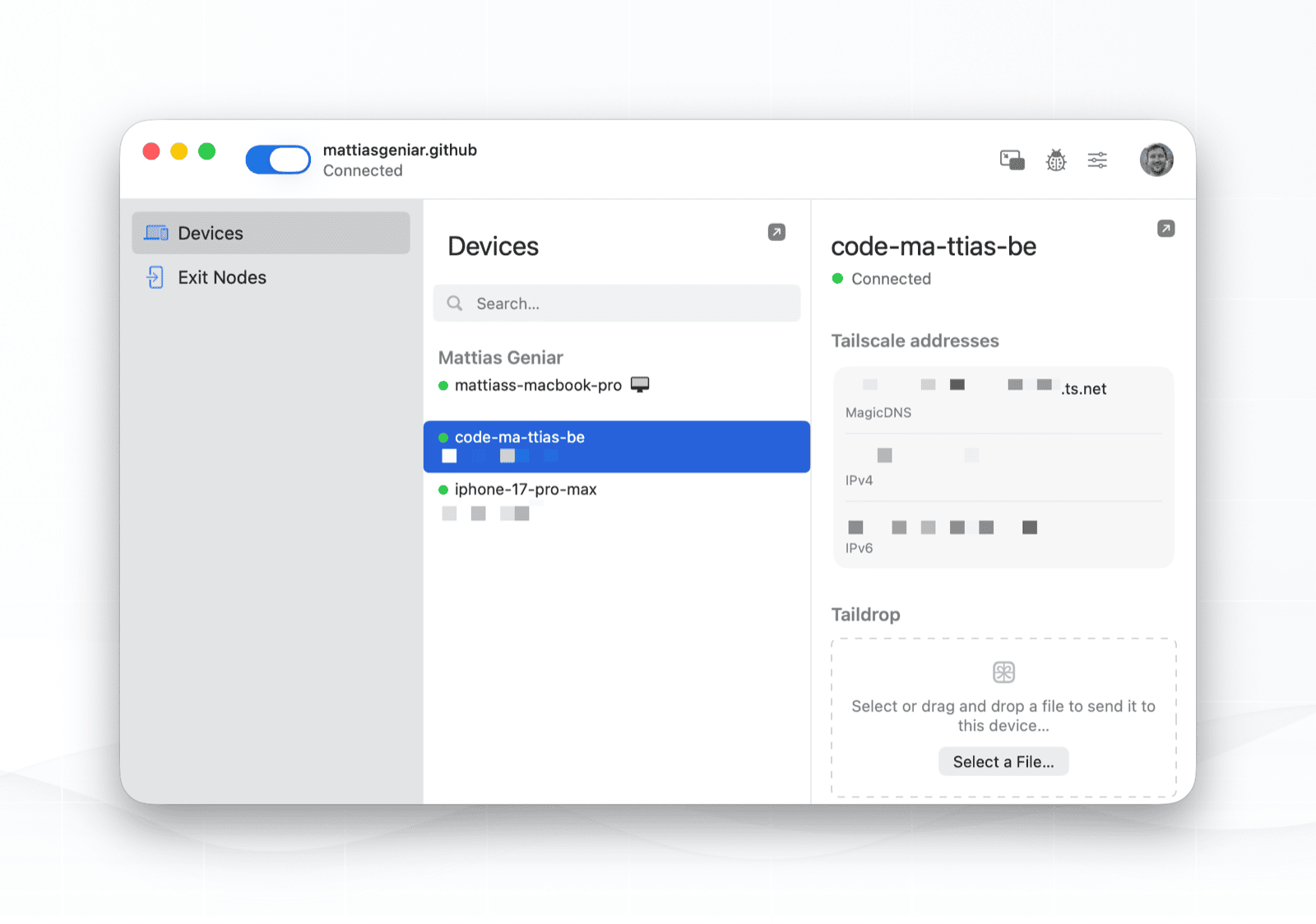
That last part is what makes the whole thing safe. The server exposes exactly one port to the public internet: SSH, and even that I keep only as a break-glass door in case Tailscale itself is ever down. Everything else, the editor, the preview servers, the databases, is bound to localhost and published only onto the tailnet. The firewall denies inbound by default and allows the tailnet interface:
$ sudo ufw status verbose
Status: active
Default: deny (incoming), allow (outgoing), disabled (routed)

To                         Action      From
--                         ------      ----
9999/tcp                   ALLOW IN    Anywhere                   # SSH (break-glass, public)
Anywhere on tailscale0     ALLOW IN    Anywhere                   # Tailnet (all services)
Tailscale also does the SSH auth for me (tailscale up --ssh), so device-to-device SSH inside the tailnet needs no key juggling, and it can hand out real, valid HTTPS certificates for your machines. That’s how the editor gets a proper https:// URL with no cert warnings, reachable from Safari on my phone, without ever being public. tailscale serve puts a localhost port onto the tailnet over HTTPS and nothing more.
If you only copy one thing from this post: put the server on a tailnet and keep it off the public internet.
The server: I started on a VPS and outgrew it#
For the first month this ran on a DigitalOcean droplet: Ubuntu 26.04 LTS, 2 vCPUs, about 8 GB of RAM, 28 GB of disk, plus a 100 GB block volume I added a few days later. That was the right way to start. It’s cheap, it’s up in sixty seconds, and it proved the idea worked before I spent real money on it.
Then I started actually using it.
Two vCPUs cope fine with one agent. They don’t cope with four. Every T3 thread is its own worktree with its own preview server, so when two of them are running a test suite while a third builds assets, two vCPUs are gone. Here’s sar on my last morning on that machine, peak one-minute load per day:
$ for f in /var/log/sysstat/sa[0-9]*; do sar -q -f "$f" | awk -v d="$(basename $f)" \
    'NR>3 && $4 ~ /^[0-9.]+$/{if($4>m)m=$4} END{if(m)printf "  %s  %.2f\n", d, m}'; done
  sa22   4.26
  sa23   3.14
  sa24   4.63
  sa25  15.04
  sa26  19.28
Load 19 on two cores means everything is queued behind everything else. And 3 GB of the 8 had been pushed out to swap, so the box was reading its own memory back off a disk.
I didn’t move because the VPS got expensive. I moved because fixing it on the same provider would have been. A CPU-Optimized droplet with 32 vCPUs and 64 GB of RAM is $672 a month. The box I ended up with is €137.
It’s from the Hetzner server auction : an i9-13900 (24 cores, 32 threads), 64 GB of DDR5 ECC, and two 1.92 TB datacenter NVMe drives, in Falkenstein. €137/month excluding VAT, no setup fee. The auction is second-hand hardware they’re clearing out, so you’re picking from whatever’s in stock that day rather than a menu, and the price ratchets down on a timer until someone buys it.
A word on picking one, because “more cores is better” is only half right. Most of what an agent makes you wait on is single-threaded: phpstan, composer, a hugo build, one pest process. There was a 32-core EPYC in the same auction for twice the money whose single-thread score is lower than the droplet I was leaving. It would have felt slower for one agent while being great for twelve. The i9 happened to be both the fastest single core and the most cores in that day’s German stock.
The same benchmark on both boxes:
| Old (2 vCPU droplet) | New (i9-13900) | |
|---|---|---|
| PHP, 3M md5, one thread | 0.58s | 0.36s |
| PHP, 3M md5, all cores | 0.88s (×2) | 0.74s (×32) |
xz -3 on 64 MB, one thread | 29.2s | 9.6s |
xz -3 on 64 MB, all cores | 17.7s | 3.4s |
openssl sha256 | 456 MB/s | 2,587 MB/s |
openssl aes-256-gcm | 10,654 MB/s | 7,717 MB/s |
dd 1 GB write | 966 MB/s | 2.5 GB/s |
Note the AES line, because it’s the one thing that got worse. The old Xeon has AVX-512 and this i9 doesn’t (Intel fused it off on consumer Raptor Lake), so OpenSSL drops from the AVX-512 VAES path to the 256-bit one. The trade runs the other way on SHA-256, where the i9 has SHA-NI and the Xeon didn’t, hence the 5.7x. Nothing I run is bottlenecked on AES throughput, so I’ll take it. But a faster CPU isn’t automatically faster at everything.
On top of the base OS it’s just a normal dev machine: git, tmux, PHP, Node, a database or two, … and Docker for anything that’s easier in a container.
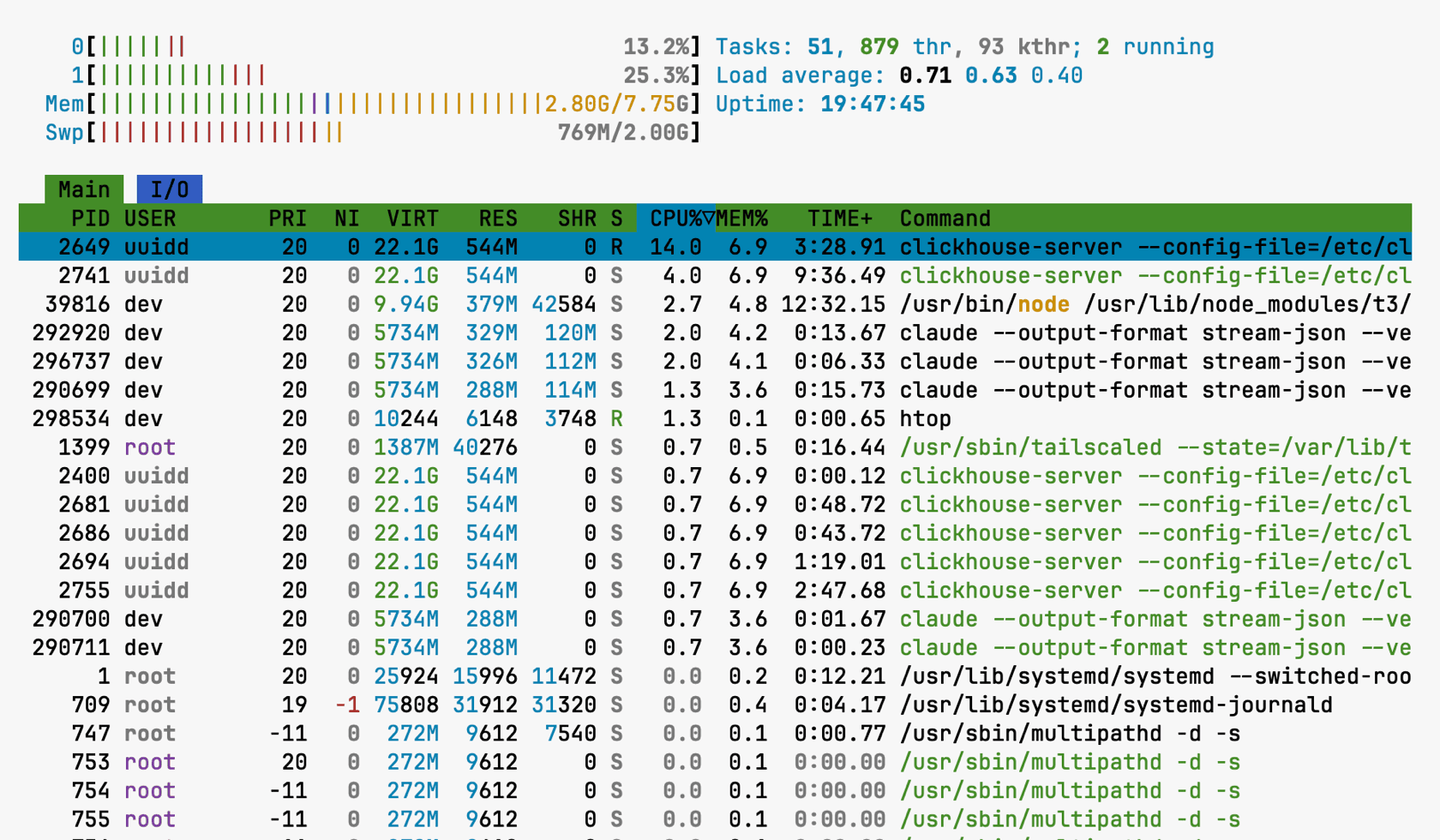
(That screenshot is the old droplet, back when two cores were still coping.)
I also turn off automatic updates on this server, which feels wrong until you think about it. Unattended-upgrades can decide to reboot at 3am, and a reboot kills every running tmux session and every in-flight agent. That’s the exact thing this setup exists to prevent. So I patch by hand, when I choose to, and let the sessions live:
$ sudo apt-get purge unattended-upgrades
$ sudo systemctl mask apt-daily.timer apt-daily-upgrade.timer
Long-running work goes in tmux, one session per project. Detach with Ctrl-b d, reattach from any device with tmux attach. That’s the fallback layer that survives everything, including the fancier GUI on top of it dying. If the browser editor ever breaks, ssh in and tmux attach and I’ve lost nothing.
One btrfs pool, mirrored across both drives#
I got this wrong when I first built this server.
Cloud images hand you ext4 as the disk by default. ext4 can’t share blocks between files, so every worktree with its own node_modules costs the full copy. Ten of them took that 28 GB disk down to 687 MB free in about a day, and I ended up deduplicating the worktrees with jdupes
to get the space back. Hardlinks work. They’re still a workaround for a filesystem that can’t share blocks.
On the droplet I fixed that by bolting on a 100 GB block volume formatted btrfs and moving /home/dev onto it. It worked, but it left the box with a 28 GB root that had nothing to do with the 100 GB where the actual work lived, and that root filled up and took the server down twice. Splitting a disk is a capacity-planning problem you get to have forever.
With two NVMe drives I don’t have to split anything. The whole machine is one btrfs pool now, mirrored across both drives, with subvolumes instead of partitions:
$ cat /proc/mdstat | grep -E '^md|blocks'
md2 : active raid1 nvme1n1p4[1] nvme0n1p4[0]
      1864754496 blocks super 1.2 [2/2] [UU]
md1 : active raid1 nvme1n1p3[1] nvme0n1p3[0]
      8379392 blocks super 1.2 [2/2] [UU]
md0 : active raid1 nvme1n1p2[1] nvme0n1p2[0]
      1046528 blocks super 1.2 [2/2] [UU]

$ findmnt -no SOURCE,FSTYPE,OPTIONS /
/dev/md2[/@] btrfs rw,noatime,compress=zstd:3,ssd,discard=async,space_cache=v2,subvolid=256,subvol=/@
Be warned though, if you’re doing this on Hetzner: installimage cannot build a native btrfs RAID1. Its own docs say so, in as many words: “no support btrfs multi-device volumes”. So the mirror is mdadm and btrfs sits on top of it. You still get reflinks, compression, subvolumes and snapshots, which is everything this setup actually uses. What you give up is btrfs repairing a bad block from the good copy, because mdadm can’t tell it which half is right. btrfs will still detect the corruption. It just can’t fix it for you.
A couple of things that cost me a cycle there. The EFI partition can’t live on mdadm (firmware can’t read it), so there’s a separate 1 GB ESP on each drive. And installimage mounts your subvolumes before it unpacks the image, so a mountpoint nested deeper than one level fails with ENOENT: my @var-lib-docker subvolume blew up the install at step 7 of 17 because /var/lib didn’t exist yet. @home and @tmp were fine. Create the deep ones afterwards.
Copy-on-write is the reason to bother with btrfs at all. cp --reflink clones a file by sharing its blocks instead of copying them, so duplicating a gigabyte costs nothing until something writes:
$ sudo btrfs filesystem df / | grep ^Data
Data, single: total=23.01GiB, used=18.39GiB
$ cp --reflink=always -a node_modules /home/dev/scratch/    # 520 MB, 32,985 files
$ sudo btrfs filesystem df / | grep ^Data
Data, single: total=23.01GiB, used=18.39GiB
That’s ohdear.app’s node_modules, half a gigabyte across nearly 33,000 files, cloned in 0.42 seconds, and the used figure doesn’t move at all. Ten checkouts of the same node_modules are that problem at scale, and this is worktree-up’s whole trick: if the worktree’s lockfile is byte-identical to the primary’s, it reflinks the dependency directory instead of installing. A fresh Laravel worktree with vendor and node_modules both cloned is ready in 1.5 seconds instead of a couple of minutes.
Update, September 2026: “a couple of minutes” was wrong. With warm Composer and npm caches on a fast disk, a cold install isn’t slow to begin with. I timed it on ohdear.app, 310 MB of vendor and 520 MB of node_modules:
| time | |
|---|---|
| reflink both | 1.34s |
cold composer install + npm ci | 7.44s |
Seconds, not minutes. Still worth having, but not the headline I made it.
There are two catches. The reflink is only trusted when the worktree’s lockfile is byte-identical to the primary checkout’s, so that checkout is the donor whether you think of it that way or not. Leave it parked on an old feature branch and every worktree (which branches off main) does a full install, and nothing tells you. One morning that was every project on the box. A timer (worktree-donor) now puts each primary checkout back on main every 15 minutes, and refuses to touch one with uncommitted changes.
The second: never run composer install on top of a vendor/ that doesn’t match the lockfile. Laravel’s post-autoload-dump hook boots the app out of the vendor/ Composer is halfway through rewriting, and it dies with Call to undefined function Illuminate\Filesystem\join_paths(). Run it again and it works, so it looks like a flake. It isn’t. Delete the stale tree first, a clean install is just as fast.
The copy-on-write part holds up, though. There are 615 worktrees on disk as I write this. du adds them up to 296 GB, while the whole filesystem stores 199 GiB of data, OS, databases and Docker images included.
I mount it with compress=zstd:3 too, so 11 GB of home sits in 7.4 GB on disk:
$ sudo compsize /home/dev
Processed 335505 files, 139334 regular extents (140869 refs), 232539 inline.
Type       Perc     Disk Usage   Uncompressed Referenced
TOTAL       62%      7.4G          11G          11G
none       100%      5.7G         5.7G         5.7G
zstd        28%      1.7G         6.1G         6.0G
The 100% line is everything already compressed (images, archives, git packs), which btrfs correctly declines to compress twice. The zstd line is the text: source, node_modules, SQL dumps.
The jdupes cron still runs, and on btrfs it now uses jdupes -B, which dedupes matching files into shared extents rather than hardlinking them, so writing to one copy can’t reach the others.
The full disk layout, /tmp included#
There’s a second default I got wrong, and it ships with every cloud image: /tmp is a tmpfs, so it lives in RAM. Ubuntu sizes it at half your memory, 3.9 GB here. A tmpfs page can’t be reclaimed until the file is deleted, so every gigabyte of build scratch stays charged to memory until something cleans it up. I caught /tmp sitting at 1.9 GB used while Shmem was only 122 MB, which means about 1.75 GB of it had been pushed out into swap. At 81% full the box had eaten its whole memory headroom: fork started failing with ENOMEM and even echo returned nothing.
So /tmp is its own subvolume in the pool now, and the ceiling went from 3.9 GB of memory to the whole 1.8 TB. Be warned though, a tmpfs gets wiped at every boot and a real filesystem doesn’t, so you want a D /tmp 1777 root root 10d line in /etc/tmpfiles.d/ to clear it at boot and age out whatever survives. nosuid,nodev because /tmp is world-writable, and noatime so reading a file doesn’t cause a write.
The whole fstab, /boot and swap included, because there’s nothing else to it:
UUID=B358-5484     /boot/efi       vfat  umask=0077 0 1
UUID=1bbb62f6-...  /boot           ext4  defaults 0 0
UUID=c0f199f5-...  none            swap  sw 0 0
UUID=fcfad565-...  /               btrfs defaults,noatime,compress=zstd:3,subvol=@ 0 0
UUID=fcfad565-...  /home           btrfs defaults,noatime,compress=zstd:3,subvol=@home 0 0
UUID=fcfad565-...  /tmp            btrfs defaults,noatime,nosuid,nodev,compress=zstd:3,subvol=@tmp 0 0
UUID=fcfad565-...  /.snapshots     btrfs defaults,noatime,compress=zstd:3,subvol=@snapshots 0 0
UUID=fcfad565-...  /var/lib/docker btrfs defaults,noatime,compress=zstd:3,subvol=@var-lib-docker 0 0
Five of those lines are the same filesystem. That’s the point of subvolumes: no line has a size, so nothing can fill up while something else sits half empty.
Keeping one agent from eating the whole server#
Added September 2026.
32 threads sounds like a lot of headroom until two agents each start a test suite. Pest takes a worker per core, so two parallel suites pinned all 32. sshd, tailscaled, MySQL and the T3 UI I was watching them from all queued up behind them.
Every agent, test suite, headless Chrome and preview server runs inside T3’s systemd service, so that’s one cgroup to cap:
# /etc/systemd/system/t3code.service.d/50-cpu.conf
# Four fifths of the box, so a test suite can never starve everything else.
[Service]
CPUAccounting=yes
CPUQuota=2560%
2560% is 80% of 32 cores. MySQL runs in its own unit, so the other fifth is exactly the room the suites need their database to have. Apply it with systemctl set-property --runtime rather than a restart, because restarting that service kills every session on the box.
The cap costs Pest nothing: one of my suites takes 40 seconds with 25 workers and with 32. Be warned though, a cgroup over its quota isn’t slowed down, it’s paused until the next 100ms period, every process in it at once. So size the worker count to the quota, not to the core count, or a browser test reads that pause as a flaky timeout.
Memory gets the same treatment, with MemoryMax=32G on the same service. That cap exists because of a Grep. On the old droplet, an agent searched a 1.1 MB minified JavaScript file for .{0,300}update-ad-group.{0,300}. Claude Code’s built-in search compiles that bounded repeat into a DFA, and on a single enormous line the DFA explodes: the kernel OOM-killed it at 5.0 GB and again at 6.5 GB, and the droplet went down with it, twice in one day. GNU grep runs the same query in 35 MB. A cap doesn’t stop the runaway, but it means the kernel kills the search instead of the SSH daemon.
And the CPU wasn’t what the test suites were waiting on anyway. With 16 parallel workers the load average sat around 5 on 32 cores: everything was waiting on MySQL. Stock MySQL ships a 128 MB buffer pool, binary logging, and a flush-to-disk on every commit. That’s the right default for data you care about. It’s pointless for a test database that gets migrated, truncated and thrown away thousands of times a day:
# /etc/mysql/mysql.conf.d/99-dev-tuning.cnf
[mysqld]
innodb_buffer_pool_size        = 12G
innodb_flush_log_at_trx_commit = 2
sync_binlog                    = 0
disable_log_bin
innodb_doublewrite             = OFF
table_open_cache               = 16000
One serial slice of the Oh Dear test suite went from 121 seconds to 48, on the same hardware. Don’t do this on a server whose data you want back after a crash. This box’s only irreplaceable data is in git.
That table_open_cache = 16000 did nothing at first. MySQL silently clamps its open-files limit to whatever systemd’s LimitNOFILE allows (10,000 by default) and shrinks the table cache to fit, down to 4,495 here, worse than the default I’d replaced. Nothing in the logs mentions it. A LimitNOFILE=65535 override on mysql.service fixed it, and I now read the values back after every restart instead of trusting the config file:
$ mysql -e "select @@open_files_limit, @@table_open_cache"
The coding GUI: T3, but bring your own#
This layer is the least settled of the three, and that’s fine.
I want a proper editor I can drive from a browser, including my phone’s browser, so I’m not squinting at tmux on a 6-inch screen when I just want to review a diff and approve a change. The server runs the editor as a service: I open a URL and there’s my project, my files, my git state, my agents.
Right now I use T3 Code
for this. It’s a web GUI that runs on the server (not on my Mac), speaks to Claude Code and Codex, does git worktrees, shows diffs, and opens pull requests. It has first-class Tailscale support, so t3 serve --tailscale-serve publishes it on tailnet-only HTTPS and I open that URL from anything. It’s early software, the project says so itself, and I’ve hit rough edges. But it does the job today.
My one current issue with T3 is that I can’t queue up multiple messages in the editor: a new message can only be sent once the agent has finished processing the previous one. That’s a matter of time, I imagine, before that’s fixed.
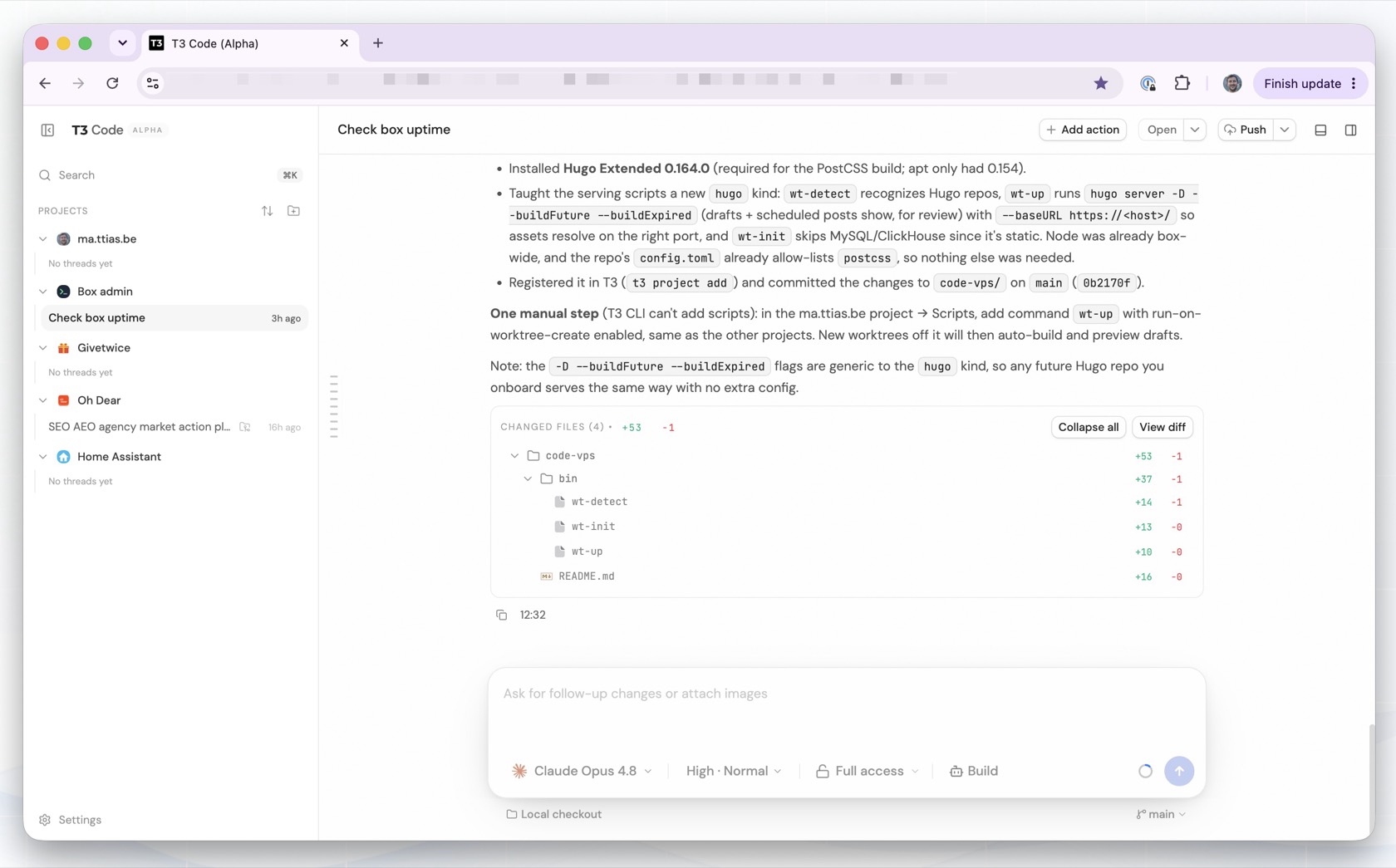
Update, August 2026: there’s a native iOS app now, T3 Code - Remote Claude & more , and it’s replaced the browser-on-my-phone half of this for me. It doesn’t replace the server, though. The app pairs with the same T3 backend running on the server, the one serving the web GUI in the screenshot above, so everything below still applies. I just get a proper app icon instead of a Safari tab.
This piece is swappable, and chances are, I’ll end up trying a few different web GUIs over the coming weeks. The whole space of “browser-based agent coding UIs” is moving fast, and a year from now the good option might be something else entirely. Nothing else in this setup depends on the specific GUI. The network is Tailscale, the server is a plain Ubuntu box, the work lives in git and tmux. If I rip out T3 tomorrow and drop in a different editor, the foundation doesn’t move. Pick whatever’s good now, and don’t marry it.
T3 itself isn’t the recommendation here, the shape is. A few others solve the same problem already: Emdash and Orca are open-source apps that run agents in parallel git worktrees, with remote-over-SSH execution so the runtime can sit on another machine. CloudCLI and Paseo go the web route like T3: a self-hosted server you reach from a browser or your phone. I haven’t run all of them in anger, so this isn’t a leaderboard.
No code editor#
I haven’t opened a real code editor in months. No VS Code, no PhpStorm, no vim beyond a quick :wq on a config file. And I don’t miss it.
That’s the biggest change in how I work. I assumed the browser GUI was me swapping my editor for a worse one I could reach from my phone. Turns out I don’t use it as an editor at all. I open T3 to read a diff, approve a change, start the next task, and watch an agent work. I almost never type code into a file by hand.
The loop now is: describe what I want, let the agent write it, read the diff, run the tests, say what’s wrong, go again. The editor used to be where I did that middle step. It’s mostly gone, and what’s left is the two ends, deciding what to build and judging whether it’s right. Those are the parts I want to be doing anyway.
So what I tuned the setup for isn’t editing, it’s that loop: how fast I get from an idea to a diff I can judge, from anywhere, without a machine I have to keep awake. A snappy editor does nothing for that. A server that runs the suite in a couple of seconds and shows me the result on my phone does.
I’m not claiming hand-coding is dead. I still read every line before it merges, and I still drop into the code when an agent is flailing. And anything that touches the database still waits until I’m at a desk . But the editor as the place I spend my day is over.
The custom sauce#
Everything above is the skeleton. These are the tweaks that make it feel like mine rather than a generic tutorial, and they’re the bits I’d miss if they were gone.
The agents update themselves every morning#
Claude Code, Codex, and T3 all ship new versions constantly. I don’t want to npm update three tools by hand every morning, and I don’t want stale versions either. A systemd timer updates all three at 05:00 my time, before I’m awake, so whatever I open is already current.
It runs on UTC (as servers should), but I pin the schedule to my actual timezone, so daylight saving never shifts it:
[Timer]
# Box runs UTC; the explicit timezone keeps this at 05:00 local year-round.
OnCalendar=*-*-* 05:00:00 Europe/Brussels
Persistent=true
If that looks like it clashes with turning off automatic OS updates earlier, the difference is what can reboot the server. An OS upgrade can, and it drags every session down with it. These don’t touch the OS: Claude and Codex just swap a binary the next run picks up, and T3 only restarts itself. That restart still drops a live T3 connection, which is exactly why it runs at 05:00 and not while I’m working.
T3 gets the careful treatment because it’s alpha software backing the UI I work in: after each update the timer health-checks it, and if the new version doesn’t come back up, it rolls back to the previous one automatically. I tested both paths on the way in, a real upgrade and a forced failure, because an auto-updater you haven’t watched roll back is just a hope.
Onboarding a workspace in one command#
Adding a project shouldn’t be a checklist I half-remember. newproject clones the repo, provisions its databases, writes its .env, and registers it in T3, which can’t add a project from its own UI on a remote server. The whole script is about a dozen lines:
#!/usr/bin/env bash
set -euo pipefail
URL="${1:?usage: newproject <git-url> [title]}"
NAME="$(basename "$URL" .git)"
DEST="$HOME/projects/$NAME"

git clone "$URL" "$DEST"
cd "$DEST"
worktree-init                                    # databases, .env, dependencies
t3 project add "$DEST" --title "${2:-$NAME}"
The real work is in worktree-init. Every project gets its own MySQL and ClickHouse database named proj_<name>, with the credentials written into .env. It reaches MySQL through a ~/.my.cnf file instead of sudo mysql, so the same script runs unattended from cron without hanging on a password prompt:
NAME="$(basename "$PWD")"
DBNAME="proj_$(printf '%s' "$NAME" | tr 'A-Z-' 'a-z_' | tr -cd 'a-z0-9_')"
DBPASS="$(sed -n 's/^DB_PASSWORD=//p' .env | head -1)"     # reuse if already set
[ -n "$DBPASS" ] || DBPASS="$(openssl rand -hex 16)"

mysql <<SQL
CREATE DATABASE IF NOT EXISTS \`$DBNAME\` CHARACTER SET utf8mb4;
CREATE USER IF NOT EXISTS '$DBNAME'@'localhost' IDENTIFIED BY '$DBPASS';
ALTER USER '$DBNAME'@'localhost' IDENTIFIED BY '$DBPASS';
GRANT ALL PRIVILEGES ON \`$DBNAME\`.* TO '$DBNAME'@'localhost';
SQL
That ALTER USER right after CREATE USER IF NOT EXISTS looks redundant, and it’s there because of a bug. IF NOT EXISTS keeps the old password when the user already exists, so the first time I deleted a project’s .env and re-ran, the freshly generated password and the database’s actual password drifted apart and the app couldn’t connect. Setting it every run keeps them in sync.
Serving is the part T3 triggers. When I start a thread, T3 makes a git worktree and runs a single setup script. Mine is worktree-up: it installs dependencies and puts the app on the tailnet. The fiddly bits are all Laravel:
# APP_URL portless: domain-scoped routes match Request::getHost(), which drops the
# port, so "host:8563" would never match. ASSET_URL WITH the port: Vite builds
# asset links from it, not the request, so portless sends every stylesheet to :443
# (that's T3 Code, not the app).
envset APP_URL   "https://$HOST"
envset ASSET_URL "https://$HOST:$PORT"

export PHP_CLI_SERVER_WORKERS=4    # php -S is single-request and self-deadlocks otherwise
nohup php artisan serve --host=127.0.0.1 --port="$PORT" >"$LOG" 2>&1 &
tailscale serve --bg --https="$PORT" "127.0.0.1:$PORT"
Every comment in there is a debugging session I only want to have once. The $PORT comes from worktree-port, which hashes the worktree name for a starting point and then linear-probes for a free one, so every worktree keeps a stable URL and two of them never fight over the same port. A naive hash % range collides about one time in five by the time you’ve got a couple of dozen worktrees, and the one that loses just fails to bind without saying anything.
Previewing worktrees#
A reader asked the practical version of this:
How do you view the output when you’re switching devices? Do you have specific domain names for all your projects so that you can use the browser?
No domains. Nothing in DNS, no reverse-proxy vhost, no per-project config anywhere. Every preview is a port on the one hostname the server already has, and that hostname comes from Tailscale: code-ma-ttias-be.tail854658.ts.net. The app binds to 127.0.0.1 on a port nobody outside can reach, and one line publishes it:
tailscale serve --bg --https="$PORT" "127.0.0.1:$PORT"
Which gets me this, one entry per running preview:
$ tailscale serve status
https://code-ma-ttias-be.tail854658.ts.net:8443 (tailnet only)
|-- / proxy http://127.0.0.1:8088

https://code-ma-ttias-be.tail854658.ts.net:8809 (tailnet only)
|-- / proxy http://127.0.0.1:8809
Same host every time, different port per worktree. worktree-port pins that port for the life of the worktree, so a branch’s preview lives at the same address today and next Tuesday.
The certificate is the part that makes this usable on a phone. Tailscale gets a real Let’s Encrypt cert for the MagicDNS name and renews it, so this is ordinary trusted HTTPS, not a self-signed thing I have to click past on iOS:
$ echo | openssl s_client -connect code-ma-ttias-be.tail854658.ts.net:8443 \
    -servername code-ma-ttias-be.tail854658.ts.net 2>/dev/null \
    | openssl x509 -noout -issuer -subject
issuer=C=US, O=Let's Encrypt, CN=YE2
subject=CN=code-ma-ttias-be.tail854658.ts.net
Switching devices is then just… opening the URL. MagicDNS resolves that name identically on my MacBook, my phone, and the iPad, so a link I open at my desk is the same string on the couch. No VPN toggle to flip, no login. And it stays tailnet-only: from the public internet that name points at a 100.x address nobody can route to.
Could I give each project a subdomain instead? Sure, and then every new project needs a DNS record, a wildcard certificate, and a vhost, all for a preview that exists for the three days the branch does. A port costs me nothing and Tailscale already owns the cert.
The catch with ports is that any dev server generating absolute URLs has to be told which one it’s on, or it points every asset at :443, where T3 lives and the app doesn’t. Laravel needs the port in ASSET_URL, as above. Hugo needs --baseURL "https://$HOST/" with the scheme, so live reload picks wss and its default appendPort tacks the :8809 back on. Two frameworks, same debugging session.
Update, September 2026: reviewing on the phone used to mean opening the preview, taking a screenshot, and pasting it back into the thread with “this sentence is wrong”. For one project I’ve since built that loop into the preview itself: worktree-up sets a flag that puts a small review toolbar on every page. I tap any sentence to rewrite it in place, pin a note anywhere, and hit Send once. The agent reads the lot with an artisan command, and each text edit comes with its translation key, so applying it is one line in one file. It can’t reach production: the app refuses review mode on the live hostname even with the flag set.
Every agent gets its own worktree#
If you run more than one agent at once, they can’t share a working directory. Two agents editing the same files on the same branch trip over each other instantly. The fix is git worktrees
: each agent gets its own checkout of the repo, on its own branch, in its own directory, all backed by the same .git.
T3 does this part for me. Start a new thread and it runs git worktree add under the hood, so I can have four agents working on four features at once, each isolated on the filesystem. That much is automatic.
The reader who nudged me toward writing this had a fair point, though. In a tool like Conductor
you press + and get a new isolated workspace with its environment already set up. T3 creates the worktree, but the environment inside it is on you. A fresh worktree is a bare checkout: no .env (it’s gitignored, so it doesn’t come along), no installed dependencies, no running app. That’s what worktree-up is for. It’s the glue Conductor bundles and T3 makes you supply: copy the .env in, composer install, start the preview. The catch is that it’s a one-time cost. You write worktree-up once per project (or, more realistically, let Claude build this once for you), flag it “run on worktree create,” and from then on every new worktree is a single click for me too. More setup up front, in exchange for controlling exactly what a worktree gets.
Update, September 2026: it’s not per project any more. T3 has a defaultProjectScripts setting in ~/.t3/userdata/settings.json that every project inherits, so one entry covers all of them:
"defaultProjectScripts": [{
  "id": "setup", "name": "Setup", "command": "/home/dev/bin/worktree-up",
  "icon": "configure", "runOnWorktreeCreate": true, "async": false
}]
async: false is the part that matters, it’s “wait for setup” in the UI. Without it the agent starts its first turn on a checkout with no vendor/ yet, sees every page return a 500, and goes off to fix bugs in code that’s fine.
worktree-up also grew into the repair step. It copies a missing .env, creates and migrates a missing SQLite database, and rebuilds the frontend assets whenever anything under resources/ is newer than the Vite manifest. That last one is the nastiest failure of the lot, because nothing errors: the preview happily serves the previous build, the old screens all work, and whatever the agent just wrote simply isn’t there. It reads exactly like a bug in the new code. I got handed a whole onboarding flow, written and tested, as a preview link serving a bundle built before its first component existed.
The isolation isn’t total, and the gap is easy to trip over. Each worktree gets its own files, its own branch, its own copied .env, and its own preview server on its own port. What they share is the database: worktree-init makes one MySQL and ClickHouse database per project, and every worktree of that project points at it. Two agents on two branches see the same tables, and a migration one of them runs lands for both. That’s usually what I want for a quick feature branch, but if you need real per-branch data isolation you’d key the database name on the branch in worktree-init rather than the project.
Update, September 2026: that’s still true for the dev database, but usually what I want was wrong for the test database. Two worktrees of the same project running their test suites at the same time would migrate and truncate each other’s tables mid-run, and pest --parallel across worktrees was just broken. Test databases now carry a suffix derived from the worktree’s directory name:
ohdear_testing                        primary checkout + CI
ohdear_testing_t3code_2cd7            the worktree t3code-1128119a
ohdear_testing_t3code_2cd7_test_16    its parallel test worker 16
The app creates them itself on the first test run, so a worktree needs no setup step. The name is a short stem plus four hex characters of an md5, because MySQL identifiers stop at 64 characters and Laravel still appends _test_<token> for parallel workers. The MySQL grant has to cover the pattern (GRANT ALL ON `ohdear\_testing\_%`.*) or a new worktree can’t create its own. And the other end matters just as much: one worktree that ran the suite at 32 processes leaves about 66 databases behind, so the reaper below drops them once the worktree is gone.
One more gap T3 leaves: there’s no “worktree removed” event, so nothing tears down the preview server when I delete a worktree. I handle that with a one-minute reaper (worktree-gc) that drops any preview whose worktree directory has vanished. Not elegant, but a merged branch doesn’t leave a dead php process and a bound port behind. This is the version I first published, about twenty lines:
Update: the reaper frees the port, but it never deletes the worktree directory, and each one carries its own node_modules. That filled the disk a day after I published this. I wrote up how I deduplicated the worktrees with jdupes
, and why copy-on-write would have been the better fix if the server weren’t on ext4.
# worktree-gc, on a one-minute systemd timer. T3 fires a script on worktree
# *create* but has no teardown event, so a merged or deleted worktree would
# otherwise leave a server and a bound port behind.
set -euo pipefail

REG="$HOME/.worktree-serve"
[ -d "$REG" ] || exit 0
shopt -s nullglob

for p in "$REG"/*.pid; do
    NAME="$(basename "$p" .pid)"
    PID="$(cat "$p" 2>/dev/null || true)"
    DIR="$(cat "$REG/$NAME.dir" 2>/dev/null || true)"

    DEAD=0
    if [ -z "$PID" ] || ! kill -0 "$PID" 2>/dev/null; then DEAD=1; fi
    if [ -n "$DIR" ] && [ ! -d "$DIR" ]; then DEAD=1; fi
    [ "$DEAD" = 1 ] || continue

    PORT="$(cat "$REG/$NAME.port" 2>/dev/null || true)"
    [ -n "$PID" ]  && kill "$PID" 2>/dev/null || true
    [ -n "$PORT" ] && tailscale serve --https="$PORT" off 2>/dev/null || true
    # (also tears down the worktree's docker compose stack, if it has one)

    rm -f "$REG/$NAME.url" "$REG/$NAME.port" "$REG/$NAME.pid" "$REG/$NAME.dir"
    echo "reaped $NAME"
done
Update, September 2026: that version had two bugs, and both were silent. tailscale serve ... off needs root or an operator, and the 2>/dev/null || true threw the 401 Unauthorized away, so every teardown left a tailnet mapping pointing at a port nothing listened on. That’s a link that answers 502 for as long as anyone keeps it. And it treated “the preview server died” the same as “the worktree is gone”, released the port, and the next worktree-up picked a new one: one worktree drifted from 8244 to 8245 to 8246 across two restarts. Now a dead server only stops the preview. The port reservation and the test databases are released only once the directory itself is gone.
The directories do get deleted now too. worktree-prune runs weekly and removes a worktree that’s merged into main, clean, older than 30 days, and not attached to a T3 thread that’s still in use. Its first version ran every week since August and never removed a single worktree. It only touched worktrees older than 30 days, on a box that was 25 days old, and it kept anything a thread had used in the past year.
One project that manages the server itself#
One of the “projects” in my editor is the server’s own admin repo. So from the same UI where I write code, I have a workspace whose job is administering the server: spin up a new project, install a package, tweak a config, check what’s running. The server can drive itself through the same agent interface as everything else. Think OpenClaw or Hermes, but for your own dev server.
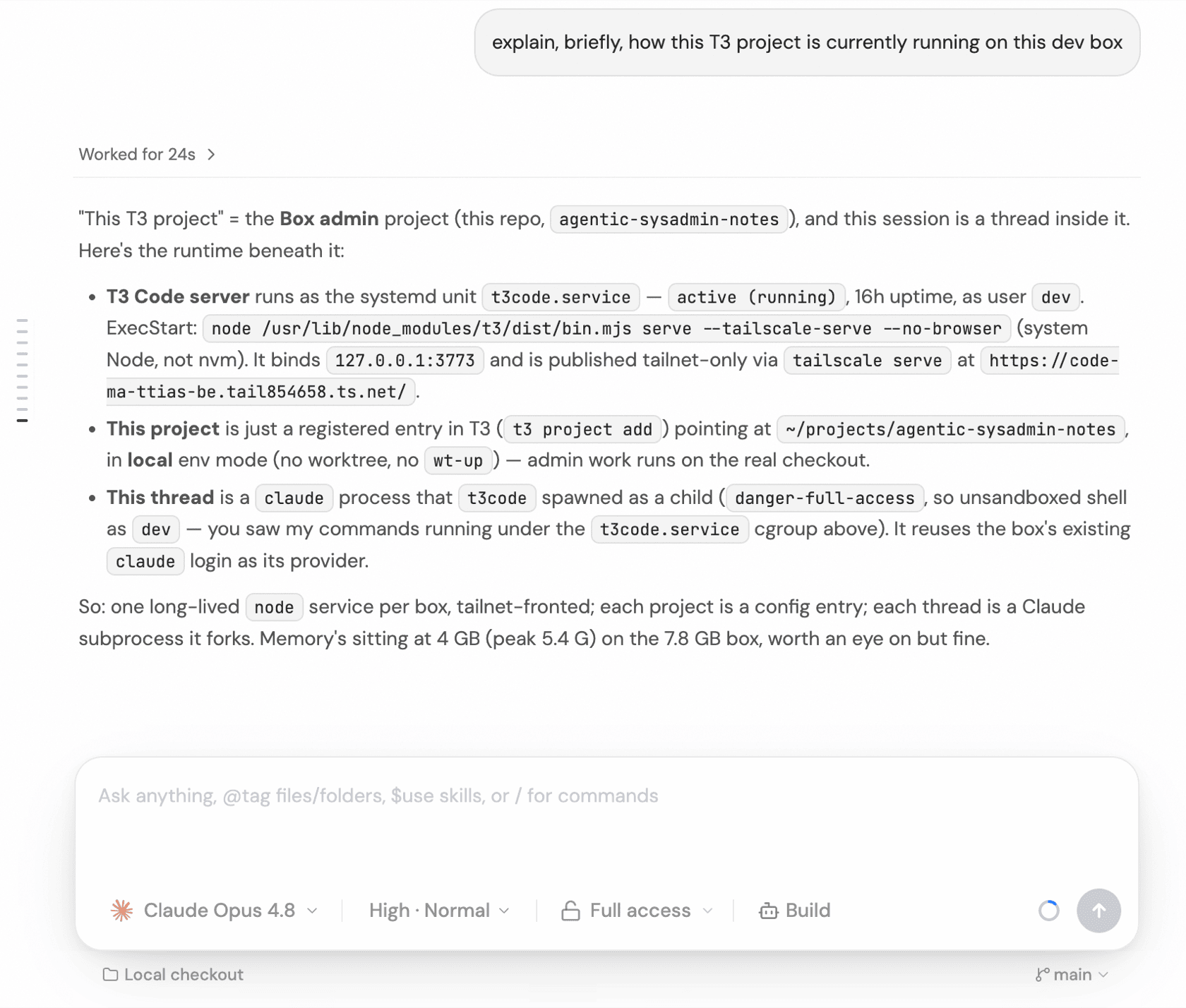
Because that admin repo is tracked in git, every change to how the server works, the scripts above included, is reviewable in a diff and deployed by copying files out of the repo instead of hand-editing live files and hoping I remember what I changed. The server’s config is code.
The details#
A pile of little decisions to save you some time:
- Anything that listens binds to
127.0.0.1and is published to the tailnet withtailscale serve. Nothing gets a public port. Be warned though: Docker’s iptables rules bypass the firewall entirely, so container ports need an explicit127.0.0.1:prefix or they end up exposed. - Databases are per-project and localhost-only, so I can throw a real MySQL and ClickHouse at any project without ever exposing them.
- Never symlink
vendor/into a scratch worktree to save an install. Composer’s autoloader resolves its base directory through the symlink, so every class loads from the other checkout. The tests go green against code that isn’t on your branch. Hardlink it (cp -al) or reflink it instead. - PHPStan caches into
/tmp/phpstan, shared by every worktree, and the cache stores absolute paths into the worktree that warmed it. Delete that worktree and every other one fails withphpstorm-stubs/Core/Core_d.stub" is not a file. That looks like a broken install and it’s neither.phpstan clear-result-cachedoesn’t fix it,rm -rf /tmp/phpstandoes.
A whole server, including cron jobs#
The Remote Control comparison from the top only goes so far. This is a full Linux server that never sleeps, and that buys a couple of things a laptop-bound setup can’t.
It runs work on a schedule. The server is awake at 6am whether I am or not, so I let it earn its keep while I sleep. Some of that is ordinary cron: the nightly database dumps, the 05:00 tool updates from earlier. Better still, put an agent on a timer. Claude Code runs headless with claude -p, so a cron line or a systemd timer can hand it a chore:
# 6am cron, while I'm asleep: bump deps and open a PR if anything moved
0 6 * * *  cd ~/projects/app && claude -p "bump composer + npm deps, run composer audit, open a PR if changed"

# Monday 7am: draft the week's changelog from the merged PRs
0 7 * * 1  cd ~/projects/app && claude -p "summarise last week's merged PRs into a changelog entry, open a PR"
Dependency bumps, a composer audit, a summary of last week’s changes for the changelog, pre-provisioning a workspace so it’s warm before I sit down, a weekly sweep for dead code. None of it needs me at the keyboard, and none of it needs my laptop powered on. I wake up to a branch, read it over coffee, and merge or bin it.
It also runs my CI so my laptop doesn’t have to. Before I push and burn real CI minutes, I run the suite on the server. It can peg all its cores at 100% spend a couple of minutes building assets and running tests, while my laptop stays cool and free for something else. (Update, September 2026: “all its cores” is exactly what I had to stop. See keeping one agent from eating the whole server
.) The agent already lives next to the code, so it runs the suite and reads its own failures without shipping anything back and forth.
One note on all this scheduled work: the more you lean on it, the more a silently-broken job costs you, and a cron line that stops firing doesn’t announce itself. If you’re starting to rely heavily on this kind of automation on your dev server, consider monitoring those cronjobs with Oh Dear too (my own product, so I’m biased, but this is exactly what it’s built for).
A workspace for Home Assistant#
Not every workspace on the server is code. One of them is my house.
I run Home Assistant at home, and it has an MCP server, the protocol agents use to talk to outside tools. So I gave the server a Home Assistant project whose MCP connection points at my house. Now, from the same T3 UI where I review a pull request, I can ask what the temperature is in the office, flip a switch, or check whether I left the garage open. From my phone, from anywhere.
The server can’t reach my home network, of course. It’s a server in a data centre, not a device on my LAN. The connection goes out through Nabu Casa , Home Assistant’s cloud, which gives my instance a stable external URL. The MCP server on it holds a long-lived token and talks to that URL. From the agent’s side it’s just another tool: it can see all 2,196 entities my Home Assistant exposes, and act on them.
An always-on server that manages my home from a chat interface, reachable from my phone – that’s most of what those self-hosted assistants are for. I didn’t set out to replace one, but between the dev workspaces, the scheduled agents, and now the house, this server has become the always-on assistant I’d otherwise have installed OpenClaw to get.
Monitoring your dev server#
This server went from a toy to something I lean on. My code lives here, my databases, the link to my house, the agents that run overnight. If it falls over, or starts leaking something I didn’t mean to expose, I want to know before I trip over it myself.
I monitor it with Oh Dear , which I co-founded, so take this as the biased recommendation it is. Uptime is the obvious half: is the server answering. The more interesting half for a server like this is port scanning .
The security model here is “one public port, everything else on the tailnet.” That holds only as long as my firewall rules stay correct, and firewall rules rot. Docker punches straight through ufw. A docker run -p 8080:8080 I forgot to pin to 127.0.0.1. A package that helpfully opens a port when I install it. From the server itself it all looks fine, while from the outside there’s now a port reachable that I never meant to expose.
Port scanning checks the server the way an attacker would, from the outside. Oh Dear scans all 65,535 TCP ports on the public IP once a day by default, more often if you want, and you tell it which ones are meant to be open. On the first scan it shows you what it found and asks you to set a baseline. On mine that’s one port, 9999, the SSH break-glass door, and nothing else:
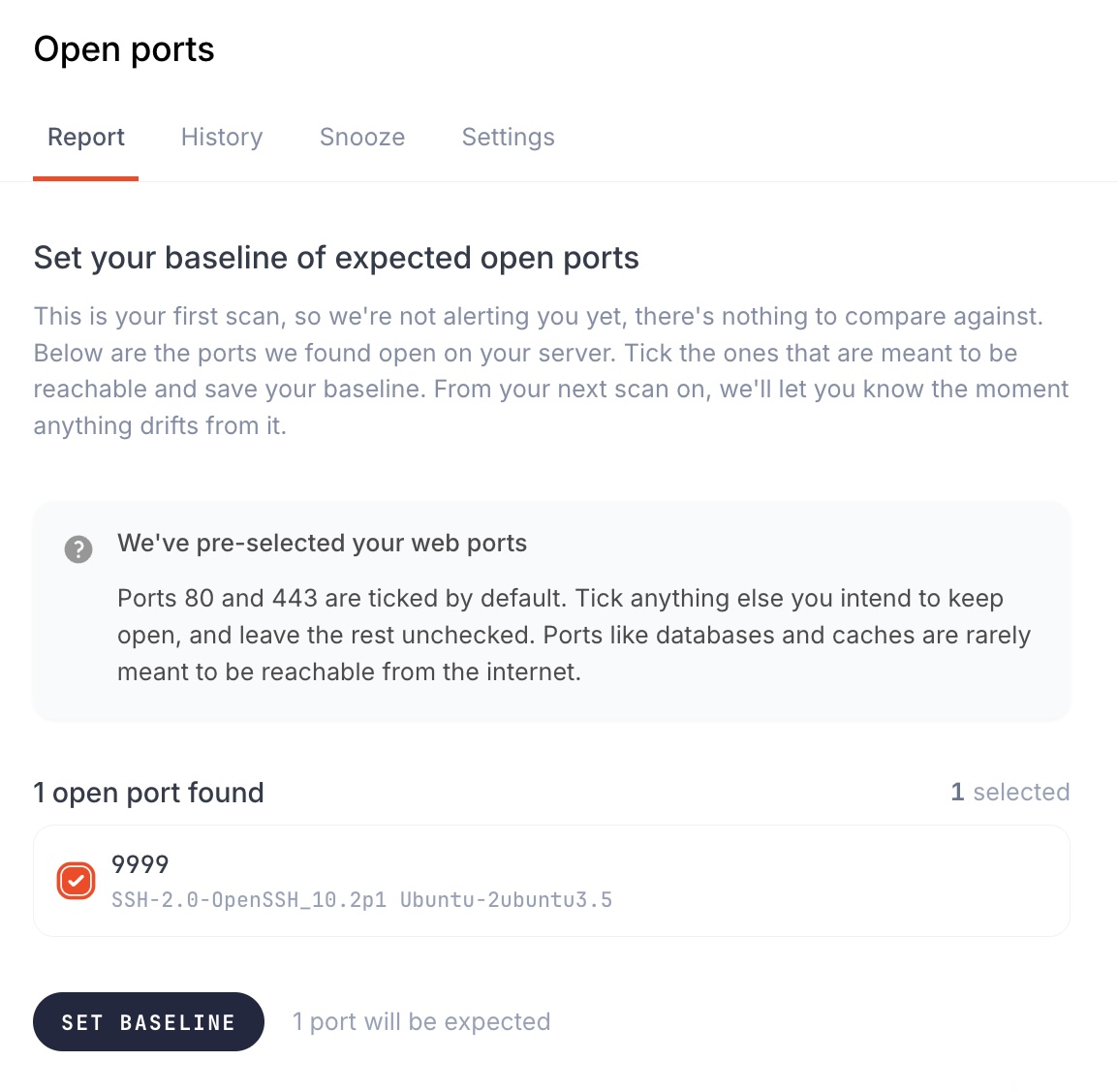
From then on, every scan is checked against that baseline. As long as 9999 is the only thing answering, it stays green. The moment an unexpected port responds, I get a notification.
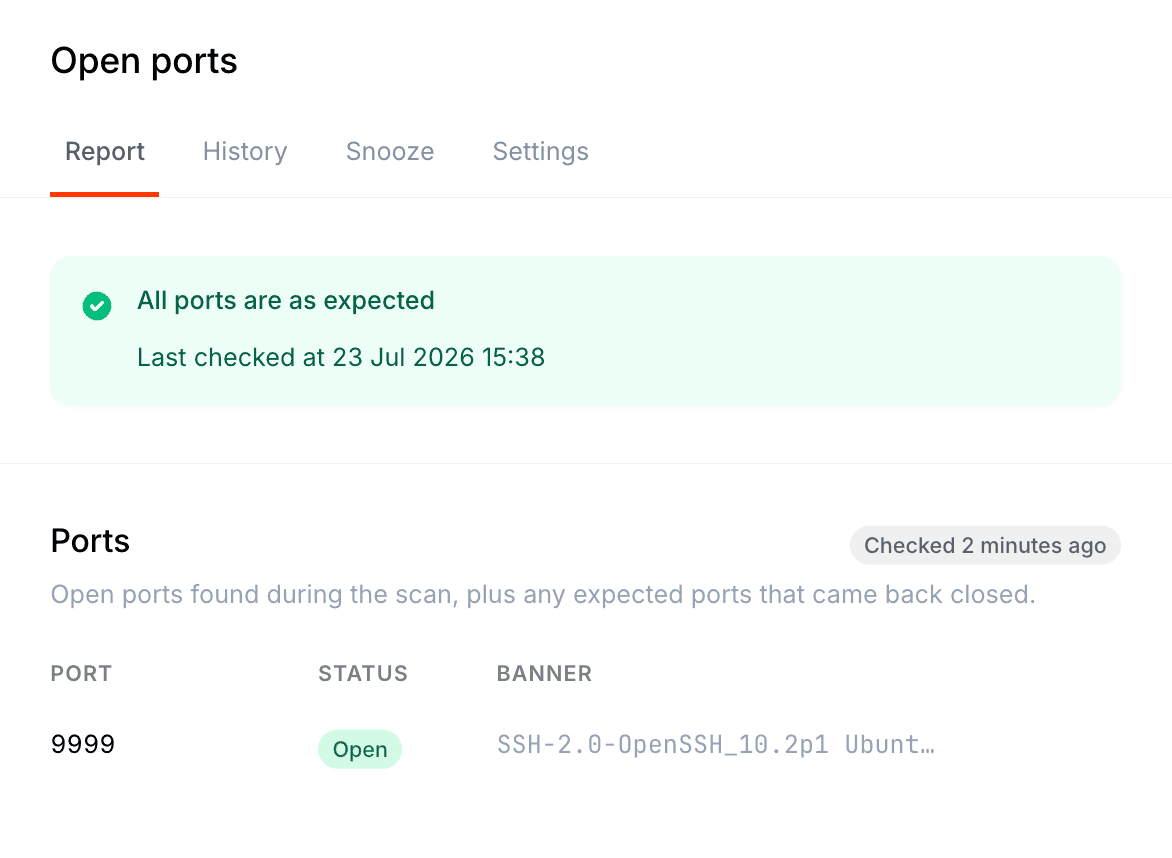
So the day I fat-finger a Docker flag and expose a database, I hear about it instead of reading about it in an incident report later. It’s the backstop for the exact mistake a tailnet-only server is one docker run away from: “ah, I thought that was firewalled.”
Hand this post to your own agent#
I said at the top this doubles as a setup guide, and I mean it literally. This post is written to be a prompt.
If you have Claude Code, Codex, or a similar coding agent, you can hand it this entire article and say “build me this on a fresh Ubuntu VPS, here’s the IP”. The agent has enough here to provision the server, install Tailscale, lock down the firewall, set up the browser GUI, and wire in the auto-updates. That’s how I’d bootstrap a second one now: give an agent the write-up and a root login, and check its work as it goes. Verify each step rather than trusting it blindly, the same way I’d review a colleague’s pull request, but the bulk of the typing is done for you.
I set out to stop keeping my laptop awake, and I ended up with an environment I can rebuild just by describing it.
If you build your own version, or you’ve got a sharper take on the GUI layer, let me know – I’d love to see what you come up with. New GUIs for this pop up weekly, chances are there’s a better one out by the time you read this.